Role of Compliance & Documentation Automation in GeM
 By Admin
- 20 Aug 2026
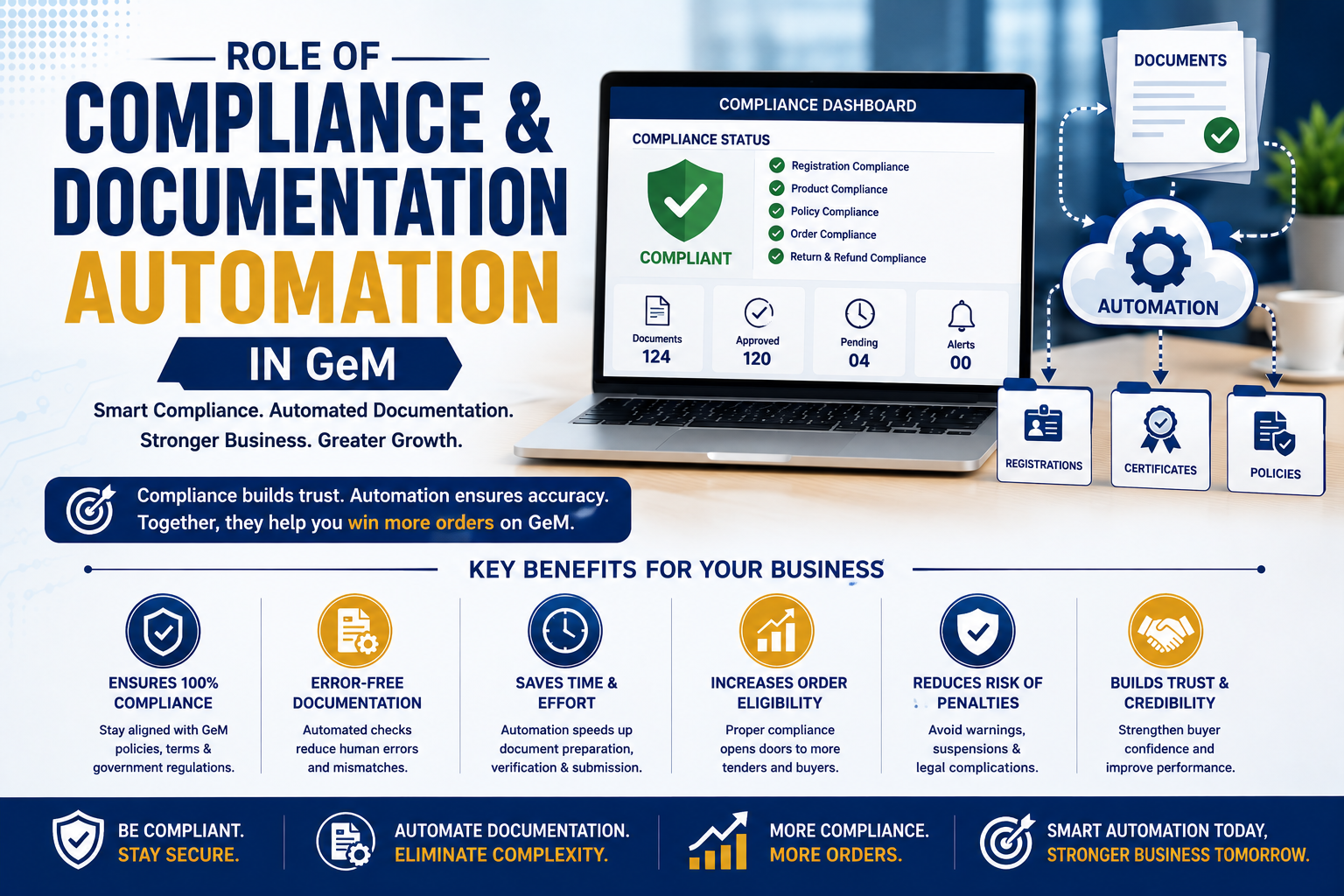
As businesses manage multiple products, bids, certificates, declarations, eligibility documents, and buyer requirements, manual documentation can become time-consuming and error-prone. This is where compliance and documentation automation can make a significant difference.
What Is Compliance & Documentation Automation in GeM ?
Compliance and documentation automation refers to using structured digital processes and tools to manage, verify, organize, and track documents required for GeM selling and bid participation.Instead of preparing every document manually, businesses can create standardized workflows for:
- Document collection and verification
- Certificate and license tracking
- Bid-specific compliance checks
- Technical document preparation
- Declarations and undertakings
- Product and catalogue information
- Submission deadlines
- Document version control
- Compliance status monitoring
Why Compliance Matters on GeM
GeM transactions involve specific eligibility and technical requirements. Depending on the product, service, or bid, sellers may need to provide information related to experience, certifications, technical specifications, financial eligibility, OEM authorization, product standards, or other requirements.A small documentation mistake can create unnecessary complications, including:
- Bid rejection due to non-compliance
- Missing or incorrect documents
- Inconsistent information across submissions
- Expired certificates
- Missed submission deadlines
- Delays in responding to buyer requirements
- Increased administrative workload
Key Role of Automation in GeM Compliance
1. Centralized Document ManagementAutomation can help businesses maintain important documents in a structured repository.
Documents such as certificates, registrations, declarations, product specifications, authorization letters, and company credentials can be categorized and accessed quickly.
This eliminates the need to search through multiple folders or email conversations every time a new bid is received.
2. Automated Document Expiry Tracking
Many business documents have validity periods. Manually monitoring expiry dates can result in missed renewals.
An automated system can maintain expiry information and provide reminders before important documents become invalid.
This helps businesses keep their compliance records updated and reduces the risk of submitting outdated documentation.
3. Bid-Specific Compliance Checklists
Every GeM bid can have different eligibility and technical requirements.
A compliance workflow can convert bid requirements into a structured checklist covering areas such as:
- Eligibility criteria
- Technical specifications
- Experience requirements
- Certifications
- Financial documents
- OEM authorization
- Undertakings and declarations
- Product/service documentation
- Additional buyer requirements
4. Reducing Human Errors
Manual documentation often creates errors such as:
- Wrong document attachment
- Missing pages
- Incorrect company information
- Outdated certificates
- Inconsistent product specifications
- Incorrect file versions
5. Faster Bid Preparation
When documents are properly organized and reusable templates are available, teams spend less time preparing repetitive paperwork.
Instead of starting from scratch for every bid, businesses can quickly access approved documents and customize only the information that is specific to the requirement.
This can significantly improve the speed of bid preparation.
Compliance Automation vs. Manual Documentation
Manual ProcessDocuments stored in different locations
Manual expiry tracking
Repeated document preparation
Manual compliance verification
Higher risk of missing documents
Time-consuming bid preparation
Difficult version control
Automated Process
Centralized document repository
Automated reminders
Reusable templates
Structured compliance checklists
Document status tracking
Faster workflow
Controlled document versions
Automation does not eliminate the need for human review. Instead, it helps teams standardize repetitive tasks while allowing professionals to focus on critical compliance decisions.
How Documentation Automation Can Improve GeM Operations
A well-designed documentation workflow can follow a simple process:Bid Identification → Requirement Extraction → Document Matching → Compliance Verification → Internal Review → Final Submission → Record Maintenance
For example, when a relevant GeM bid is identified, the team can first review the eligibility requirements. Required documents can then be mapped against the company's document repository. Missing or expired documents can be identified before the final submission stage.
This creates a more organized and accountable bidding process.
Benefits for MSMEs and Startups
Compliance automation can be particularly valuable for MSMEs and startups that operate with small teams.
Instead of assigning significant employee time to repetitive documentation tasks, businesses can establish standardized processes that make compliance easier to manage.
Key benefits include:
- Time savings: Reduce repetitive administrative work.
- Better accuracy: Minimize documentation mistakes.
- Improved preparedness: Keep essential documents ready.
- Better deadline management: Track important dates and requirements.
- Scalability: Handle more bids without proportionally increasing administrative workload.
- Audit readiness: Maintain organized records of submitted documents.
Best Practices for GeM Documentation Automation
Businesses planning to automate their compliance process should follow a few important practices.Maintain a Master Document Repository
Keep current versions of all frequently used business documents in one organized system.
Use Standardized Templates
Create approved templates for declarations, undertakings, authorization letters, and other frequently required documents.
Track Expiry Dates
Maintain expiry information for certificates, registrations, licenses, and other time-sensitive documents.
Create Bid-Wise Compliance Checklists
Do not assume that the same documentation applies to every bid. Review each bid independently and map its requirements.
Implement a Review & Approval Process
Automation should include a human verification stage before final submission. Critical documents and declarations should be reviewed by an authorized person.
Maintain Document Version Control
Ensure that teams use the latest approved version of each document and avoid accidentally submitting outdated files.
Protect Sensitive Business Information
Documentation systems should have appropriate access controls to protect confidential company and financial information.
Common Mistakes to Avoid
Even with automation, businesses should avoid treating compliance as a purely technical activity.
Common mistakes include:
- Automating without understanding the actual bid requirements.
- Using the same documents for every GeM bid without verification.
- Failing to review automatically matched documents.
- Ignoring document expiry dates.
- Maintaining multiple outdated versions of the same document.
- Waiting until the last day to complete compliance checks.
- Uploading documents without verifying their accuracy and relevance.
The Future of GeM Compliance
As government procurement becomes increasingly digital, businesses will need more organized and technology-driven compliance processes.
Future-ready tender operations are likely to focus on:
- Digital document repositories
- Automated compliance workflows
- Expiry alerts
- Bid requirement mapping
- Standardized documentation
- Digital approvals
- Data validation
- Centralized bidding records
- AI-assisted document analysis
Conclusion
Compliance and documentation are critical components of successful GeM participation. While manual processes may work for a limited number of bids, they can become difficult to manage as a business expands its product portfolio and bidding activities.Compliance and documentation automation can help businesses reduce errors, save time, improve document readiness, and create a more structured GeM bidding process.
However, technology should support not replace professional compliance review. Businesses that combine automation, standardized processes, accurate documentation, and expert verification can build a stronger foundation for sustainable growth in government procurement.
Classic Tenders is India’s top-rated GeM portal registration consultancy for MSMEs, DPIIT startups, OEMs, manufacturers, traders, resellers, and service providers. Our end-to-end GeM seller onboarding services include profile setup, GeM vendor assessment exemption & assistance, brand registration, OEM panel authorization, catalog listing, product and service category uploading, GeM tender participation (L1 & Reverse Auction), caution money management, direct purchase order processing, and continuous account administration across all 28 states and 8 union territories.


 Live Chat