Reverse Auction in GeM Portal
 By Admin
- 15 May 2026
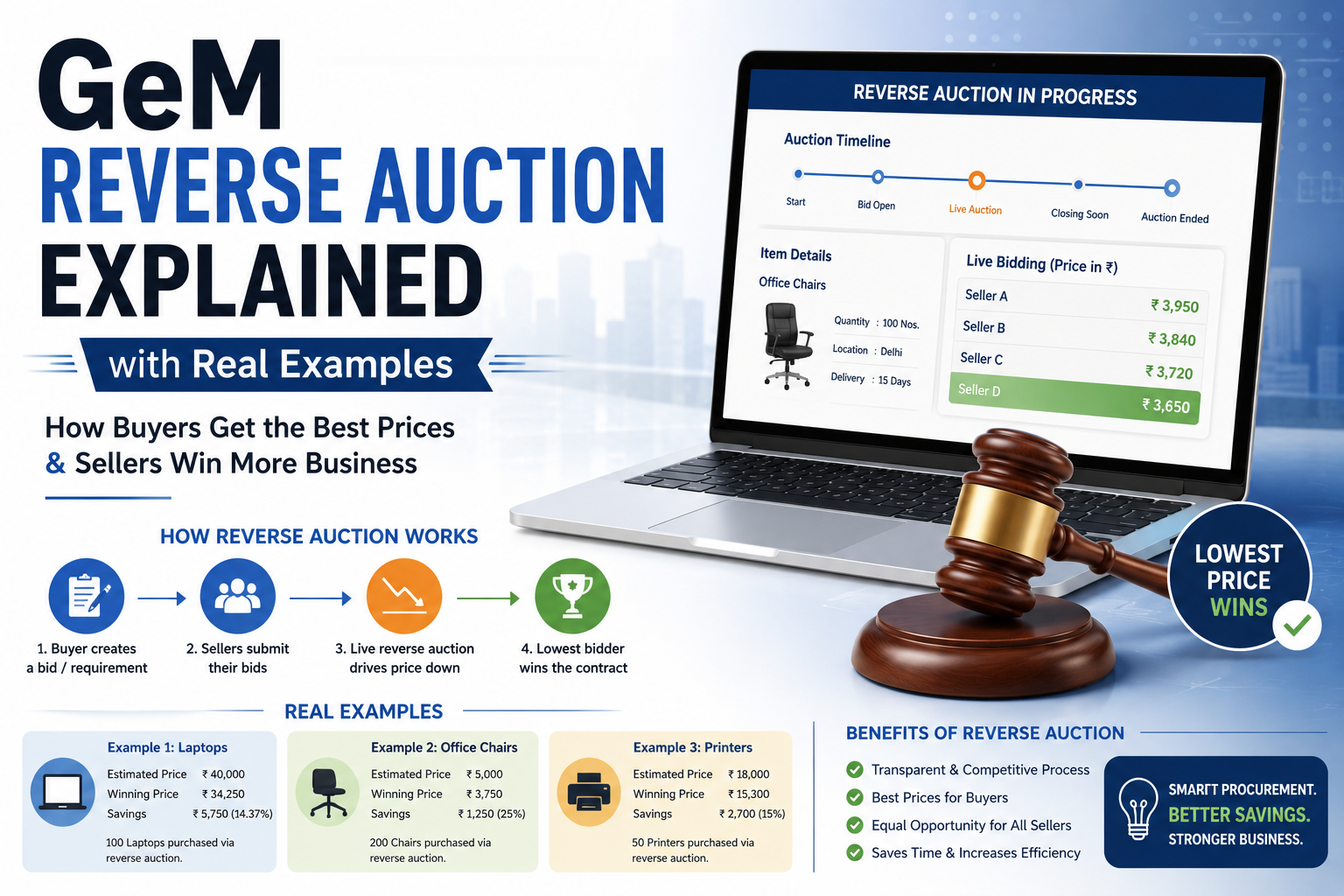
The Government e-Marketplace (GeM) has transformed the way government departments purchase goods and services in India. One of the most powerful and competitive features on the GeM portal is the Reverse Auction (RA) process.
For many sellers and service providers, Reverse Auctions can feel confusing or risky at first. Questions like:
- How does GeM Reverse Auction work?
- Why do prices keep decreasing?
- Can small businesses win Reverse Auctions?
- What strategy should sellers follow?
What is a GeM Reverse Auction?
A Reverse Auction on GeM is a type of online bidding process where multiple sellers compete by reducing their prices to win a government order.Unlike normal auctions where buyers bid higher prices, in a Reverse Auction:
✅ The buyer wants the lowest price
✅ Sellers continuously lower their quotes
✅ The lowest eligible bidder usually wins the order
The GeM portal conducts this process online in real time.
Why Government Buyers Use Reverse Auctions
Government departments use Reverse Auctions to:- Get competitive market prices
- Ensure transparency in procurement
- Save public money
- Increase vendor participation
- Reduce manual negotiation
When is Reverse Auction Used on GeM ?
Reverse Auctions are commonly used when:
- The product specifications are clear
- Multiple suppliers are available
- The requirement is bulk quantity
- Price comparison is important
- Computers & laptops
- Printers
- Furniture
- Electrical items
- CCTV systems
- Stationery supplies
- Solar products
- Security services
- Housekeeping services
Types of Reverse Auctions on GeM
1. Reverse Auction OnlyIn this method:
- Sellers directly participate in live price reduction
- Lowest eligible bidder wins
A department wants to buy:
- 100 office chairs
Suppliers participate:
| Supplier | Initial Quote |
| ABC Furniture | ₹4,850 |
| XYZ Seating | ₹4,700 |
| Prime Office | ₹4,650 |
During Reverse Auction:
| Supplier | Final Price |
| ABC Furniture | ₹4,400 |
| XYZ Seating | ₹4,320 |
| Prime Office | ₹4,280 |
2. Bid + Reverse Auction
This is the most common method on GeM.
Step 1 — Technical & Financial Evaluation
The buyer checks:
- Product specifications
- Experience
- Certifications
- Eligibility documents
Step 2 — Live Reverse Auction
Qualified bidders compete by lowering prices.
How GeM Reverse Auction Works Step-by-Step
Step 1 — Buyer Publishes BidThe government department uploads:
- Product/service details
- Quantity
- Eligibility criteria
- Bid end date
- Reverse Auction terms
Suppliers upload:
- Product details
- Price quote
- Technical documents
- Certifications
The buyer shortlists technically qualified bidders.
Only eligible sellers enter the Reverse Auction.
Step 4 — Reverse Auction Starts
GeM notifies qualified bidders.
During the auction:
- Sellers can see rank positions
- Competitors’ names are hidden
- Participants reduce prices strategically
If a bidder reduces price near closing time:
⏰ GeM automatically extends the auction time.
This prevents last-second unfair bidding.
Step 6 — Lowest Bidder Wins
The seller with:
✅ Lowest price
✅ Technical qualification
✅ Compliance with terms
wins the order.
Important Terms in GeM Reverse Auction
L1 Bidder
The lowest eligible bidder.
Start Price
The maximum or starting price for bidding.
Bid Decrement Value
Minimum amount by which price must reduce.
Example
If decrement value = ₹5,000
Then:
❌ ₹10,00,000 → ₹9,97,000
✅ ₹10,00,000 → ₹9,95,000
Auto Extension
Auction time increases automatically when bids come near closing time.
Advantages of Reverse Auction for Sellers
1. Transparent ProcessEverything happens online.
No hidden negotiations.
2. Equal Opportunity
Even small MSMEs can compete with large companies.
3. Faster Procurement
Results are declared quickly.
4. Higher Business Opportunities
Thousands of government buyers use GeM daily.
Risks of Reverse Auction
1. Extreme Price CompetitionMany suppliers reduce prices aggressively.
2. Low Profit Margins
Winning at very low prices can create losses.
3. Emotional Bidding
Some sellers panic and reduce prices irrationally.
Smart Strategy to Win GeM Reverse Auctions
1. Calculate Minimum Sustainable Price
Before auction starts, determine:- Product cost
- GST
- Delivery cost
- Installation cost
- Service support
- Profit margin
2. Avoid Early Aggressive Reduction
Wait and observe competitor movement.Many experienced bidders reduce prices only near closing time.
3. Improve Technical Eligibility
Strong technical qualification reduces competition.Add:
- OEM authorization
- ISO certifications
- Experience certificates
- Past performance documents
4. Focus on Less Crowded Categories
Highly competitive products create price wars.Niche products often provide better margins.
5. Maintain Good Seller Rating
Government buyers prefer reliable sellers with:- Good delivery history
- Positive ratings
- Low cancellation rate
Common Mistakes Sellers Make
Bidding without Cost Calculation
This leads to losses after winning.
Ignoring Service Costs
AMC, installation, transportation, and manpower costs are often underestimated.
Last-Minute Internet Issues
Poor connectivity during live auction can cause missed opportunities.
Always use stable internet.
Participating Without Reading Bid Terms
Some bids include:
- Heavy penalties
- Strict delivery timelines
- Performance security requirements
Can MSMEs Win Reverse Auctions?
Yes absolutely.
Many MSMEs regularly win GeM orders because:
- Government departments encourage MSME participation
- Small firms often respond faster
- Local suppliers reduce logistics costs
- Specialized service providers face lower competition
✅ Pricing strategy
✅ Compliance
✅ Product quality
✅ Timely execution
than company size alone.
Final Thoughts
GeM Reverse Auctions are one of the most important procurement mechanisms in government purchasing today.
Businesses that understand:
- Pricing strategy
- Cost management
- Technical compliance
- Smart bidding tactics
The key is not simply offering the lowest price it is offering the lowest sustainable and compliant price while maintaining profitability and service quality.
With proper planning and experience, Reverse Auctions can become a powerful growth opportunity for suppliers, traders, manufacturers, and service providers across India.
Classic Tenders is one of the top e-marketplace consulting companies offering GEM registration services in Ahmedabad, Gujarat. We provide step-by-step assistance in the GEM Portal Services. We have an expert team of well-trained professionals that are known for their efficiency for GEM registration in India. Contact Us Today Our GEM Portal Services are easy, safe and secure. Here all concerns for GEM Portal Related are treated with perfection.


 Live Chat