How to Get More Orders on GeM in 2026
 By Admin
- 23 Oct 2026
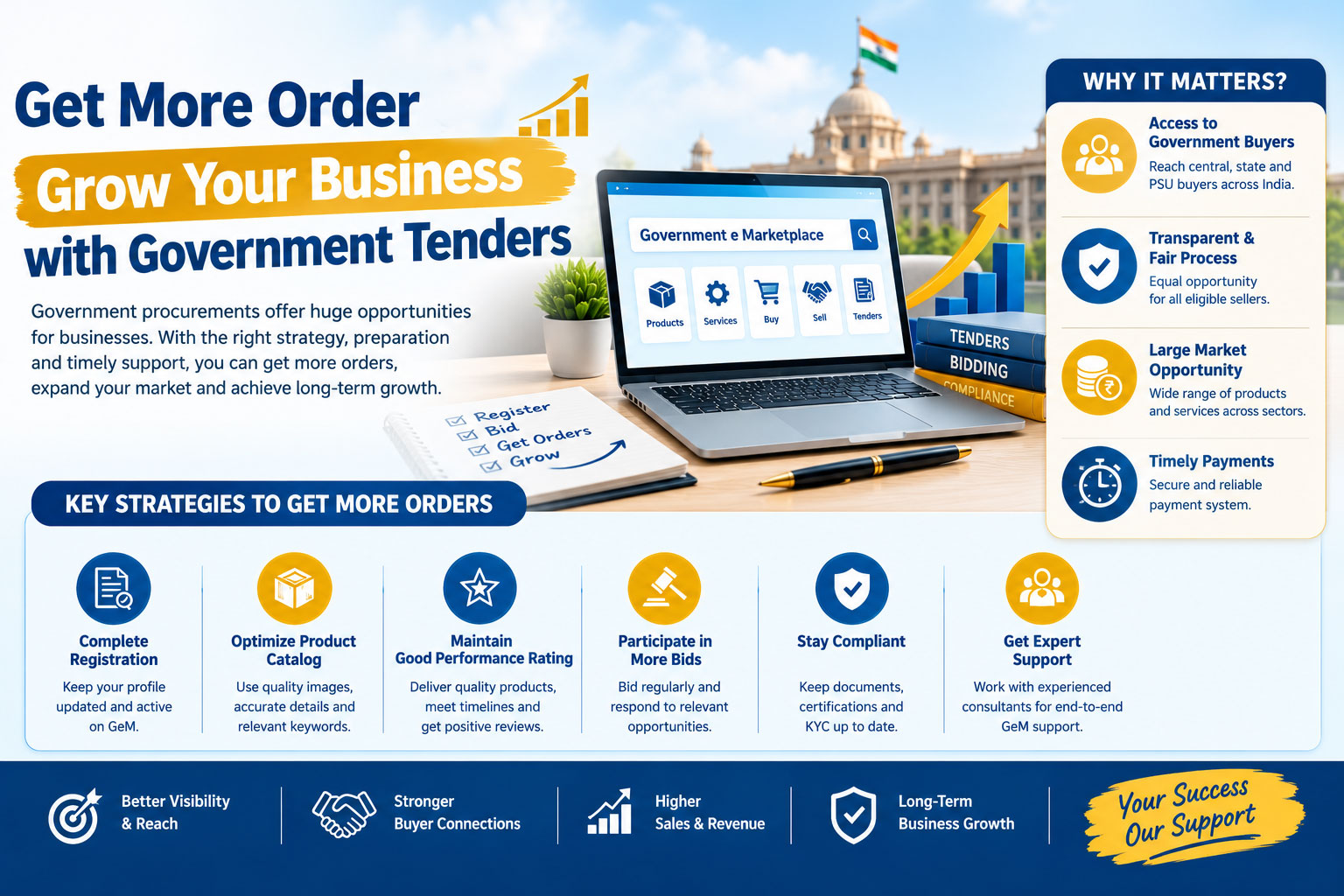
If your GeM seller account is active but you are not receiving enough orders, it may be time to review your selling strategy.
In this blog, we will explain how to get more orders on GeM, improve your chances of winning government tenders, and build a sustainable business on the Government e-Marketplace.
Introduction
The Government e-Marketplace (GeM) has created significant business opportunities for manufacturers, traders, MSMEs, and service providers looking to supply products and services to government departments, public sector undertakings (PSUs), and other eligible government organizations.However, simply registering on the GeM Portal does not guarantee regular orders. Sellers need to maintain accurate product catalogues, offer competitive prices, identify suitable bidding opportunities, submit compliant bids, and deliver orders according to the contract requirements.
What Is GeM and How Does It Help Sellers Get Government Orders?
The Government e-Marketplace (GeM) is an online public procurement platform that enables eligible government buyers to procure goods and services from registered sellers and service providers. It supports different procurement methods, including catalogue-based purchases and electronic bidding, subject to applicable rules and platform requirements. Official Government Services Portal.For sellers, GeM provides an opportunity to reach government buyers beyond their local markets.
Businesses can explore two important routes to generating orders:
- Catalogue-based selling: Make eligible products or services available to buyers through accurate, competitive listings.
- Bid and Reverse Auction (RA) participation: Identify suitable government requirements and submit bids according to the published eligibility criteria and terms.
9 Proven Strategies to Get More Orders on GeM
1. Optimize Your GeM Seller Profile
Your seller profile establishes your business identity on the GeM Portal. Incomplete, inaccurate, or outdated information can create difficulties during verification, catalogue management, and bid participation.To maintain a reliable seller profile:
- Complete the applicable business and seller registration details.
- Verify PAN, GSTIN, bank account, and other required information.
- Maintain accurate business addresses and contact details.
- Update relevant business information whenever changes occur.
- Keep required financial, registration, and eligibility documents ready.
- Check your account regularly for pending actions or compliance requirements.
Pro Tip: Review your seller account periodically instead of waiting until an important bid deadline to identify missing information.
2. Create an Accurate and Attractive Product Catalogue
Your product catalogue is an important part of your GeM selling strategy. Buyers need to find products that match their requirements, specifications, and procurement needs.An inaccurate or incomplete catalogue may reduce your chances of being considered for relevant purchases.
Follow these catalogue optimization practices:
- Select the correct product category and applicable specifications.
- Use clear, genuine product images where permitted.
- Provide accurate technical specifications and product descriptions.
- Enter the correct brand, model, manufacturer, and other required details.
- Maintain realistic pricing and available stock information.
- Update product offerings and other details whenever required.
GeM provides dedicated learning resources for catalogue management and seller account administration. Sellers can refer to the official GeM Interactive Learning Management System for guidance.
Pro Tip: Do not upload products randomly. Focus on accurate listings for the products your business can supply reliably.
3. Use Competitive and Profitable Pricing
Pricing is an important factor in government procurement. Buyers may compare eligible sellers on price, technical specifications, delivery conditions, and other applicable criteria.However, offering the lowest price on every product is not always a sustainable strategy.
Before finalizing your prices, calculate:
- Product manufacturing or purchase cost.
- Packaging and transportation expenses.
- Applicable taxes.
- Installation or service costs, where relevant.
- Warranty and after-sales support expenses.
- Other costs associated with fulfilling the order.
Example: If your competitor offers a product at a lower price, first verify whether the product specifications and commercial terms are equivalent. Reduce your price only when the order remains commercially viable.
Pro Tip: Aim for competitive pricing that protects your margins rather than submitting unsustainably low quotations.
4. Find Relevant GeM Bids Every Day
One of the practical ways to increase your chances of receiving government orders is to monitor relevant bids consistently.Many sellers miss suitable opportunities because they search irregularly or discover tenders too close to the submission deadline.
Build a daily bid-monitoring routine using relevant product names, service categories, technical keywords, and buyer requirements.
For every potential opportunity, check:
- Bid submission deadline.
- Required product or service specifications.
- Eligibility criteria.
- Past experience requirements, if applicable.
- EMD or other financial requirements, where applicable.
- Required certifications and supporting documents.
Pro Tip: Prepare a shortlist of relevant bids rather than applying for every available tender. A carefully selected opportunity is often more valuable than a large number of unsuitable submissions.
5. Submit Complete and Compliant Bid Documents
Documentation errors can undermine an otherwise competitive bid. Missing certificates, incorrect declarations, inconsistent business details, or incomplete technical submissions may result in rejection, depending on the bid conditions.Before submitting any bid:
- Read the complete bid document and all applicable amendments.
- Prepare a checklist of mandatory documents.
- Verify the validity and applicability of certificates.
- Match your technical offer against the required specifications.
- Check financial information and declarations.
- Review all uploaded documents for readability and correctness.
- Submit the bid before the deadline and retain the relevant records.
Pro Tip: Complete your internal document review well before the deadline so there is time to correct errors or clarify requirements.
6. Maintain Your Product Availability and Delivery Capability
Government buyers need suppliers who can fulfil orders according to the applicable contractual requirements.Even when your products are competitively priced, inaccurate availability information or unrealistic delivery commitments can create problems.
To improve your order fulfilment readiness:
- Keep catalogue information current.
- Monitor stock and production capacity.
- Coordinate with manufacturers, distributors, and logistics partners.
- Confirm realistic delivery schedules before accepting commitments.
- Plan packaging, transportation, and installation where applicable.
- Maintain records of dispatches and order-related communications.
Pro Tip: Accept orders only when you can fulfil them in accordance with the applicable terms and conditions.
7. Maintain Strong Order Fulfilment and Performance Records
Winning an order is only one part of building a successful GeM business. Sellers must also fulfil orders properly and comply with contractual obligations.Poor fulfilment can lead to disputes, delays, financial consequences, or other contractual issues.
After receiving an order:
- Review the order details and applicable contract conditions.
- Confirm the delivery schedule and fulfilment requirements.
- Arrange the required goods, resources, or services.
- Complete dispatch, delivery, installation, or service milestones as applicable.
- Maintain supporting delivery and acceptance records.
- Submit invoices and other required documents through the applicable process.
- Follow up on pending contractual or payment-related matters through official channels.
Pro Tip: Maintain an order tracker showing order value, delivery date, current status, invoice status, and outstanding actions.
8. Keep Your Certifications and Business Documents Updated
Depending on your business category and the particular bid, government procurement opportunities may require specific registrations, certificates, technical approvals, or other supporting documents.
Examples may include:
-
Udyam/MSME registration, where applicable.
-
GST registration and tax-related records, as required.
-
ISO certification, where relevant to the business and bid.
-
Startup recognition, where applicable.
-
Digital Signature Certificate (DSC), where required for the relevant process.
-
OEM authorization or manufacturer-related documents, where required.
-
Product-specific approvals, test reports, or quality certificates.
Having a certificate does not automatically make a seller eligible for every tender. Always verify the exact requirements in the applicable bid.
Pro Tip: Maintain a digital document folder with expiry dates and renewal reminders for documents that require periodic renewal.
9. Get Professional GeM Consultancy and Bidding Support
Managing GeM registration, product catalogues, documentation, bid monitoring, and tender submissions can require considerable time and attention.
Businesses without a dedicated tender team may find it difficult to manage these activities consistently while handling their regular operations.
Professional GeM consultancy and tender bidding support can help businesses organize their processes and identify suitable opportunities.
Depending on the agreed scope of services, support may include:
-
GeM seller registration assistance.
-
Product catalogue creation and management.
-
Relevant bid and tender information.
-
Bid document review and eligibility checks.
-
Technical and commercial documentation support.
-
Bid submission assistance.
-
Compliance and order fulfilment guidance.
Professional assistance does not guarantee that a seller will win a bid or receive an order. Final outcomes depend on eligibility, competition, buyer evaluation, pricing, and the applicable procurement conditions.
Pro Tip: Choose a service provider that explains the process clearly, follows official procedures, protects your business information, and avoids promises of guaranteed government orders.
Common Mistakes That Prevent Sellers from Getting More Orders on GeM
Even registered sellers can struggle to generate orders when they overlook important operational details.
Avoid these common mistakes:
-
Incomplete seller profiles: Missing or inconsistent information can cause avoidable issues.
-
Incorrect product categories: Buyers may not find offerings that are listed under unsuitable categories.
-
Outdated catalogues: Incorrect specifications, prices, or availability can reduce competitiveness.
-
Unprofitable pricing: Bidding below a sustainable cost can create losses.
-
Irrelevant bid participation: Applying without meeting eligibility requirements wastes time and resources.
-
Incomplete documentation: Missing or incorrect documents can affect bid evaluation.
-
Missed deadlines: Late submissions may not be accepted.
-
Poor order management: Delayed deliveries and incomplete fulfilment can create contractual problems.
-
Neglecting compliance: Expired or inapplicable documents can affect eligibility.
-
Expecting instant results: Building a sustainable government procurement business requires preparation, monitoring, and consistent execution.
Addressing these issues can help your business develop a more systematic approach to GeM selling.
How Classic Tenders Can Help You Get More Orders on GeM
At Classic Tenders, we help businesses navigate government procurement opportunities with tender information, GeM-related assistance, and tender bidding support. Our services can help you organize important activities involved in participating in government procurement, allowing you to focus on your products, services, and business growth.
Our services include:
-
GeM Portal Services: Assistance with seller registration and related account requirements.
-
Product Catalogue Support: Assistance with product listing and catalogue management.
-
Tender Information Services: Information about relevant government tender opportunities.
-
Tender Bidding Services: Assistance with bid documentation and submission processes.
-
Tender Consultancy: Guidance on understanding bid requirements and preparing for participation.
-
Certification Services: Assistance with relevant business certification processes, subject to applicable requirements.


 Live Chat