How Government Certifications Help in Tender Technical Qualification
 By Admin
- 29 Aug 2026
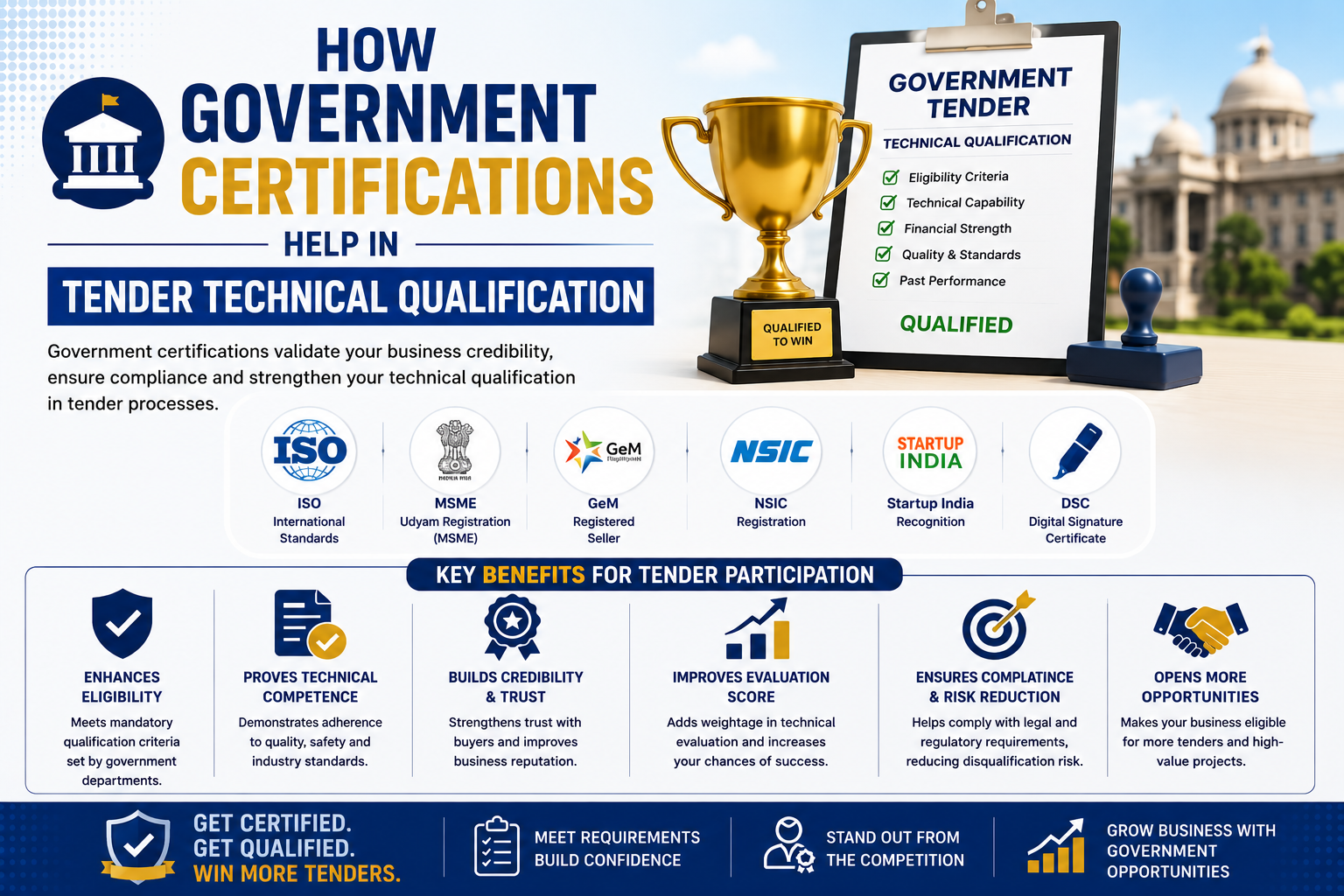
Government tenders are a major business opportunity for MSMEs, startups, manufacturers, suppliers, contractors, and service providers. However, winning a tender is not only about offering the lowest price. Before financial bids are evaluated, bidders often need to satisfy several technical qualification and eligibility requirements.
One of the most important ways businesses can strengthen their tender eligibility is by maintaining the right government registrations, certifications, and compliance documents.
In this blog, we’ll explain how government certifications can support technical qualification in tenders, which certifications are commonly relevant, and how businesses can prepare their documentation effectively.
What Is Technical Qualification in Government Tenders?
Technical qualification is the stage where the buyer evaluates whether a bidder has the required experience, capabilities, registrations, certifications, manpower, infrastructure, product quality, and technical compliance to execute the contract.
Depending on the tender, the technical evaluation may consider:
- Relevant work experience
- Similar work orders
- Turnover requirements
- Product specifications
- Quality certifications
- Manufacturer/OEM status
- MSME or startup status
- Statutory registrations
- Technical manpower
- Infrastructure and machinery
- Past performance
- Financial and technical documents
A bidder that fails to meet a mandatory technical requirement may be technically disqualified, even if its price is competitive.
How Certifications Support Tender Technical Qualification
Certifications and registrations can demonstrate that your business meets specific eligibility or compliance requirements mentioned in the tender document.1. MSME/Udyam Registration
Udyam Registration establishes a business as a registered MSME. Where a tender provides MSME-related benefits or specifically asks for MSME documentation, having valid registration can help the bidder claim applicable benefits.Depending on the tender and applicable government rules, MSMEs may receive benefits such as:
- Tender fee exemptions
- EMD exemptions
- Purchase preferences
- Relaxations in certain eligibility criteria
2. Startup India Recognition
For eligible startups, DPIIT Startup Recognition can be valuable when participating in government procurement.
Some tenders provide specified relaxations for recognized startups, such as relaxation in:
-
Prior experience
-
Prior turnover
-
EMD requirements
These benefits depend on the procuring authority, tender conditions, and applicable government policies.
For a startup competing with established businesses, applicable relaxations can significantly improve its ability to qualify technically.
3. ISO Certification
ISO certification can demonstrate that an organization follows a structured management system.
Common certifications relevant to tenders include:
-
ISO 9001 – Quality Management System
-
ISO 14001 – Environmental Management System
-
ISO 45001 – Occupational Health & Safety Management
-
ISO 27001 – Information Security Management System
However, ISO certification should not be treated as a universal tender qualification. If the tender does not require or recognize a particular certification, possessing it does not automatically make a bidder technically qualified.
4. Digital Signature Certificate (DSC)
A Digital Signature Certificate (DSC) is essential for many electronic tendering processes.
It can be used for:
-
Signing tender documents
-
Submitting bids electronically
-
Signing declarations
-
Completing e-procurement procedures
While DSC is generally an e-tendering requirement rather than a technical qualification certificate, an invalid, expired, or improperly configured DSC can prevent a bidder from successfully submitting its bid.
Therefore, businesses should ensure their DSC is valid well before the tender submission deadline.
5. OEM and Vendor Certifications
Manufacturers and authorized suppliers may need to provide documents establishing their relationship with the original equipment manufacturer (OEM).
Depending on the tender, relevant documents may include:
-
OEM authorization
-
Manufacturer certificate
-
Authorized dealership certificate
-
Distributor certificate
-
Product compliance certificates
-
Test reports
-
Product-specific certifications
These documents can be particularly important when the tender specifies a particular brand, manufacturer authorization, technical standard, or product compliance requirement.
6. Product-Specific Certifications and Test Reports
Some tenders require products to comply with specific Indian or international standards.
Depending on the product category, buyers may ask for:
-
BIS certification
-
Product test reports
-
Laboratory reports
-
Safety certifications
-
Quality compliance certificates
-
Calibration certificates
-
Performance certificates
These documents help the buyer verify whether the proposed product meets the technical specifications stated in the tender.
Always check the exact certification requirement in the tender. A generic certificate may not satisfy a requirement for a particular standard, model, product category, or testing authority.
7. GeM-Related Certifications and Vendor Compliance
For businesses selling through the Government e-Marketplace (GeM), maintaining accurate seller information and required compliance documents is important.
Depending on the product and category, sellers may encounter requirements relating to:
-
OEM status
-
Vendor Assessment
-
Product certifications
-
Brand authorization
-
Product specifications
-
Legal and statutory documents
-
Category-specific compliance
A properly maintained GeM profile can make it easier to respond to relevant bid requirements and avoid documentation-related issues.
Certifications vs. Technical Qualification: What's the Difference?
A common misconception is that simply having multiple certificates guarantees tender qualification.
It doesn't.
Think of it this way:
Certification = Evidence of a particular capability/compliance
Technical Qualification = Meeting ALL mandatory eligibility requirements of the tender
For example, a bidder may have:
-
ISO 9001
-
Udyam Registration
-
Startup India Recognition
-
GST Registration
-
Valid DSC
But if the tender requires 3 years of similar work experience and the bidder cannot satisfy that mandatory condition, the bidder may still be technically disqualified.
Certification Readiness Checklist for Tender Bidders
Before participating in a government tender, check whether you have:
✅ Udyam/MSME Registration, where applicable
✅ Startup India/DPIIT Recognition, where applicable
✅ Relevant ISO Certification
✅ Valid Digital Signature Certificate
✅ GST and statutory registrations as required
✅ OEM/Manufacturer Authorization, where applicable
✅ Product-specific certifications
✅ Test and inspection reports
✅ Experience certificates/work orders
✅ Turnover and financial documents
✅ Technical compliance documents
✅ Signed declarations and undertakings
How Classic Tenders Can Help
Preparing certifications is only one part of becoming tender-ready. Businesses also need to identify suitable tenders, understand eligibility conditions, prepare compliance documents, and submit bids correctly.
Classic Tenders provides tender-related support for businesses looking to participate in government procurement, including tender information, tender bidding support, GeM services, and certification-related assistance.
A structured approach can help businesses reduce documentation errors and improve their tender-readiness.
Conclusion
Government certifications can play an important role in tender technical qualification, but their value depends on the exact requirements of each tender.
Udyam Registration, Startup India Recognition, ISO certifications, OEM authorizations, product certifications, test reports, and other compliance documents can help establish eligibility or satisfy specific technical requirements when they are expressly required or applicable.
The key is not to collect certifications blindly. Instead, businesses should identify the certifications and documents most relevant to their industry, products, services, and target tenders.


 Live Chat