ISO Certification for Startups: Is It Worth the Investment ?
 By Admin
- 16 Jun 2026
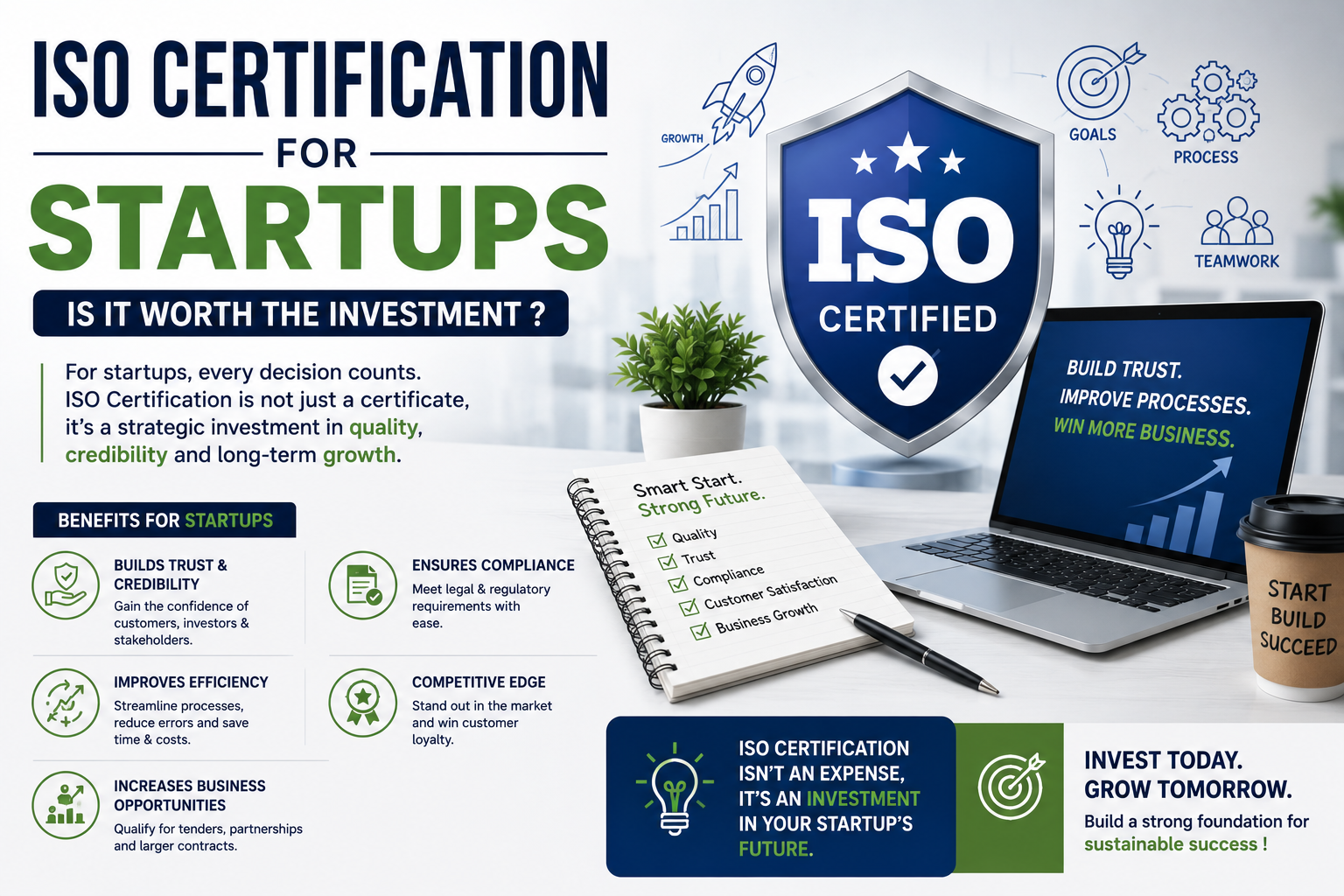
For startups, every investment decision matters. Whether it's hiring talent, developing products, or marketing services, founders carefully evaluate the return on investment (ROI) before spending money. One such decision that often raises questions is ISO Certification.
In this blog, we'll explore what ISO Certification is, its benefits for startups, costs involved, and whether it's worth the investment.
What Is ISO Certification ?
ISO (International Organization for Standardization) develops globally recognized standards that help businesses improve quality, efficiency, security, and customer satisfaction.Some popular ISO standards for startups include:
- ISO 9001 – Quality Management System
- ISO 27001 – Information Security Management System
- ISO 14001 – Environmental Management System
- ISO 45001 – Occupational Health & Safety Management System
- ISO 22000 – Food Safety Management System
Why Startups Should Consider ISO Certification
1. Builds Credibility and Trust
New businesses often struggle to gain customer confidence because they lack an established reputation.ISO Certification acts as a third-party validation that your startup follows structured processes and quality standards.
Benefits include:
- Increased customer trust
- Enhanced brand image
- Stronger market positioning
- Better client retention
2. Helps Win Government Tenders
Many government departments and public sector organizations prefer or require ISO-certified vendors.For startups planning to participate in:
- Government tenders
- GeM Portal opportunities
- PSU contracts
- Large infrastructure projects
This makes certification particularly valuable for startups operating in manufacturing, IT services, consulting, construction, and engineering sectors.
3. Improves Internal Processes
Startups often face challenges such as:- Lack of documented procedures
- Inconsistent workflows
- Communication gaps
- Operational inefficiencies
As a result:
- Productivity improves
- Errors reduce
- Teams work more efficiently
- Growth becomes easier to manage
4. Attracts Corporate Clients
Many large organizations prefer working with certified vendors because they want reliable partners.Having ISO Certification can:
- Help qualify for vendor registration
- Increase acceptance in procurement processes
- Improve chances of enterprise-level contracts
5. Supports Funding and Investor Confidence
Investors often evaluate operational maturity before investing.An ISO-certified startup demonstrates:
- Professional management practices
- Risk management capabilities
- Process-driven operations
- Long-term growth readiness
6. Enhances Customer Satisfaction
Customer satisfaction is critical for startup survival.ISO standards focus heavily on:
- Understanding customer requirements
- Managing feedback
- Continuous improvement
- Delivering consistent quality
- Repeat business
- Positive reviews
- Referrals
- Stronger brand reputation
- ISO 27001
- ISO 9001
- ISO 9001
- ISO 14001
- ISO 45001
- ISO 22000
- HACCP-related standards
- ISO 9001
- ISO 13485 (Medical Devices)
- ISO 9001
The cost depends on:
- Company size
- Number of employees
- Certification standard
- Business complexity
- Certification body selected
Costs generally include:
- Gap analysis
- Documentation
- Implementation support
- Internal audits
- Certification audit fees
Potential Challenges
Before pursuing certification, startups should be aware of some challenges:Time Commitment
Documentation and process implementation require management involvement.Employee Training
Teams must understand and follow documented procedures.Continuous Compliance
ISO Certification is not a one-time activity. Regular audits and continual improvement are required.Initial Cost
Early-stage startups with limited budgets may need to plan the investment carefully.Is ISO Certification Worth the Investment ?
Yes, If Your Startup Wants To:
✅ Participate in government tenders✅ Register on procurement platforms
✅ Win corporate clients
✅ Improve operational efficiency
✅ Build market credibility
✅ Scale systematically
✅ Strengthen investor confidence
It May Not Be Urgent If:
❌ You are still validating your business idea❌ Operations are extremely small and informal
❌ You have no immediate need for tenders or enterprise clients
❌ Budget constraints are severe
Even in these cases, planning for certification as your startup grows can be a smart long-term strategy.
ROI of ISO Certification for Startups
The return on investment often comes from:- Increased business opportunities
- Higher tender eligibility
- Better customer retention
- Reduced operational errors
- Improved productivity
- Enhanced brand reputation
Conclusion
ISO Certification is more than just a certificate it is a framework for building a professional, scalable, and trustworthy business.For startups looking to establish credibility, improve operations, attract larger clients, and participate in government procurement opportunities, ISO Certification can deliver substantial long-term value.
While the initial investment requires planning, the benefits often outweigh the costs, making ISO Certification a worthwhile strategic decision for growth-oriented startups.
If your startup aims to scale, compete with established businesses, and build long-term trust in the market, ISO Certification is an investment worth serious consideration.
Classic Tenders Provide End to End ISO Certification Services. Let us assist you in navigating the ISO registration process seamlessly, ensuring you get ISO certification efficiently and effectively, empowering your business for success in today's competitive market.


 Live Chat